
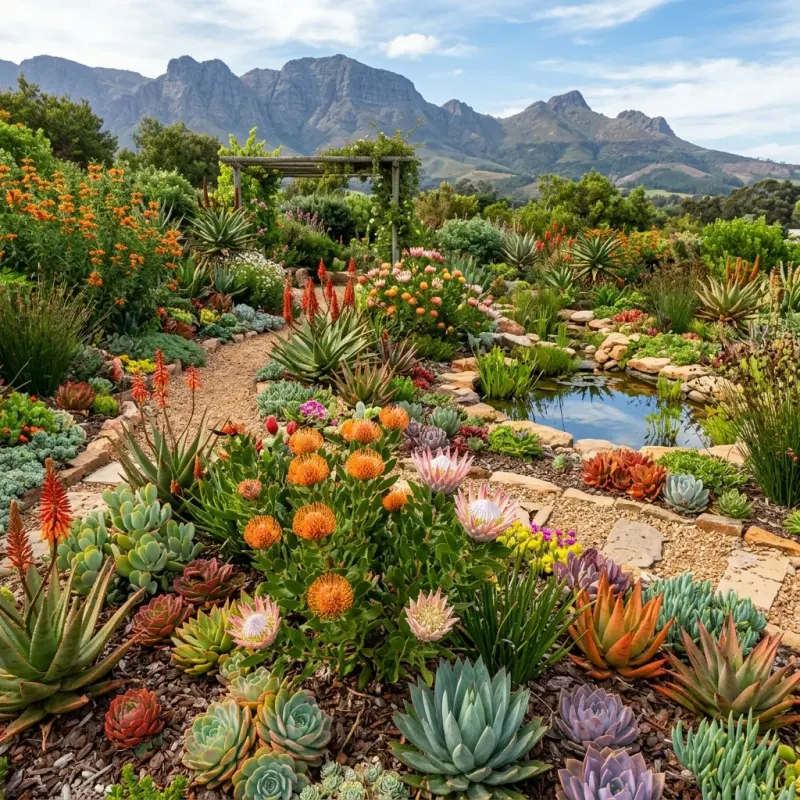
The Complete Guide to Water-Wise Gardening in South Africa
South Africa is a water-scarce country. We receive less than half the global average annual rainfall, and that rainfall is unevenly distributed — with the Western Cape Mediterranean climate delivering rain in winter, the summer rainfall regions of Gauteng, KwaZulu-Natal, and Limpopo relying on seasonal thunderstorms, and large portions of the Northern Cape and Karoo existing in near-desert conditions year-round. Cape Town's Day Zero water crisis of 2018 sent a warning to the entire country that cannot be ignored: the way most South African gardens are currently planted and maintained is ecologically and financially unsustainable.
Water-wise gardening — also called xeriscaping — is not about having a sparse, rocky garden with a few struggling succulents. Done well, it produces some of the most spectacular, wildlife-rich, and low-maintenance gardens imaginable — gardens that work with South Africa's extraordinary natural heritage rather than fighting it with imported plants, synthetic fertilisers, and irrigation systems that drain our diminishing water reserves. This guide gives you everything you need to plan, plant, and maintain a genuinely water-wise South African garden that is beautiful in every season.
Understanding Water-Wise Gardening: The Core Principles
Water-wise gardening rests on seven interconnected principles that, taken together, drastically reduce your garden's water demand while improving its health, resilience, and ecological value:
- Planning and design: Group plants by water requirement, consider sun and shade patterns, and design for the specific microclimate of your garden.
- Soil improvement: Healthy soil with good structure retains moisture longer, requires less watering, and supports robust plant root systems.
- Appropriate plant selection: Choosing species naturally adapted to your region's rainfall patterns is the most impactful single decision in water-wise gardening.
- Practical turf management: Conventional lawn grasses are among the thirstiest elements of any garden. Reducing lawn area and switching to drought-tolerant alternatives dramatically cuts water use.
- Efficient irrigation: Drip irrigation delivers water directly to root zones with minimal evaporation. Watering in the early morning further reduces loss.
- Mulching: A thick organic mulch layer is one of the highest-return investments in any water-wise garden.
- Appropriate maintenance: Water-wise gardens require less maintenance than conventional gardens — but the maintenance they do need is different.
The Best Water-Wise Plants for South African Gardens
South Africa's indigenous flora represents thousands of years of adaptation to our specific rainfall patterns, soil chemistry, and climate extremes. These plants have evolved precisely the mechanisms needed to thrive in our conditions without supplemental irrigation once established.
Spekboom (Portulacaria afra) — The Miracle Plant
Spekboom deserves a special mention before any other plant in a South African water-wise context. This remarkable succulent shrub — known as Elephant Food in English and Spekboom in Afrikaans — is indigenous to the Eastern Cape thicket biome and is among the most ecologically significant plants in the world. Spekboom is a CAM (Crassulacean Acid Metabolism) plant, meaning it opens its stomata at night to absorb CO₂ (when temperatures are cooler and humidity higher, reducing water loss) and fixes it into sugars during the day with the stomates closed. This unique mechanism makes it extraordinarily drought-tolerant while simultaneously making it one of the most effective carbon-sequestering plants on earth — hectare for hectare, a Spekboom thicket sequesters more carbon than a temperate forest.
For gardeners, Spekboom is practically indestructible. It propagates from a cutting pushed into the ground with no additional care. It grows in virtually any soil, tolerates heavy frost, intense heat, and extended drought. It can be trimmed into a neat hedge, left to grow as a sprawling shrub, or kept as a container plant. It produces small pink flowers in spring that attract bees and other pollinators. It is edible — the leaves have a pleasant, slightly tart flavour and are nutritious. Every South African garden, from a compact townhouse plot to a large rural property, should have Spekboom in it.
Proteas and Fynbos — South Africa's Floral Crown Jewels
The Proteaceae family — which includes Proteas, Leucadendrons, Leucospermums (Pincushions), and Grevilleas — produces some of the most spectacular flowers on earth. South Africa is a global centre of Protea diversity, with hundreds of species endemic to the Western and Eastern Cape. Despite their exotic appearance, Proteas are remarkably tough once established, requiring very little supplemental water in their adapted zones.
Key growing requirements: Proteas require well-drained, slightly acidic soil with low phosphorus levels — most commercial fertilisers contain phosphorus levels that are lethal to Proteas, so choose a fertiliser specifically formulated for Proteaceae or indigenous plants. They thrive in full sun and dislike root disturbance — plant them once and let them be. In suitable climates (Western Cape, high-altitude areas of the Eastern Cape, parts of the Western Highveld), they are extraordinarily drought-tolerant once a 2-year establishment period is complete.
Ecological value: Protea flower heads are among the most important food sources for sunbirds, sugarbirds, and a range of specialized insects in the fynbos biome. Planting them creates a living wildlife sanctuary in your garden.
Aloes — Architectural Beauty and Ecological Significance
South Africa has over 130 indigenous Aloe species, ranging from the massive tree aloe (Aloe barberae, the world's largest aloe) to compact ground-hugging species suited to rockeries and containers. Aloes are among the most valuable plants you can grow for winter colour in South African gardens — they flower predominantly from May to August when most other plants are dormant, providing a critical winter food source for sunbirds that depend on nectar through the cold months.
Top choices for gardens:
- Aloe ferox (Cape Aloe): Bold, architectural form with spectacular orange-red winter torches. Hardy to frost and drought. Also the source of the potent skincare ingredient covered in our guide to natural SA beauty ingredients.
- Aloe arborescens (Krantz Aloe): Multi-stemmed, fast-growing, and spectacular in large drifts. Produces abundant orange flowers through winter and makes a formidable security hedge.
- Aloe vera: The classic, widely available medicinal aloe. Thrives in containers and garden beds in frost-free areas. A practical addition to any SA garden given its skincare and first-aid applications.
Cape Honeysuckle (Tecoma capensis)
Few plants deliver as much garden value for as little effort as the Cape Honeysuckle. This vigorous, fast-growing shrub produces dense clusters of vivid orange or yellow tubular flowers from late summer through winter — precisely when the garden needs colour most. It tolerates poor soil, drought, frost (once established), wind, and neglect. It can be trained as a climber over a trellis or pergola, clipped into a formal hedge, or left to grow as an informal specimen shrub. Its flowers are irresistible to sunbirds, making it one of the best plants in the country for attracting these extraordinary birds to your garden. Available in orange (the standard species) and yellow (Tecoma capensis 'Aurea') varieties.
Wild Dagga (Leonotis leonurus)
Wild Dagga — also called Lion's Tail — is one of the most striking tall perennials in South African gardening. It grows in dramatic upright spikes to 2 metres, producing whorls of vivid orange flowers at each stem junction throughout autumn and winter. It is extraordinarily drought-tolerant, thrives in full sun, grows in poor soil, and self-seeds readily once established. More importantly for garden ecology, its tubular orange flowers are perfectly shaped for sunbird pollination, making it one of the best plants in the country for attracting Malachite Sunbirds, Amethyst Sunbirds, and White-bellied Sunbirds. It requires virtually no maintenance once established — simply cut back hard in late winter before new growth emerges.
Agapanthus (African Lily)
Agapanthus is one of South Africa's most beloved garden plants for excellent reasons: it is virtually indestructible, produces spectacular blue, white, or purple flower heads from November through February, requires minimal water once established, and thrives in both full sun and partial shade. It is perfect for mass planting along driveways, borders, and slopes where erosion control is needed. Its thick, fleshy roots store water, making it drought-tolerant through dry spells, and it is tolerant of frost, poor soil, and neglect. The large, globular seed heads that follow flowering are architecturally striking in their own right.
Water-Wise Gardening Strategies That Make the Biggest Difference
Mulching — The Single Highest-Return Garden Practice
If you implement only one water-wise strategy from this guide, make it mulching. A 7–10cm layer of organic mulch (wood chips, bark, composted leaves, or sugar cane mulch) applied around plants delivers a remarkable range of benefits simultaneously:
- Reduces soil evaporation by up to 70%, dramatically cutting watering frequency
- Keeps soil temperature cooler in summer and warmer in winter — both beneficial for root health
- Suppresses weed growth, reducing competition for moisture
- Feeds the soil as it decomposes, improving structure and water retention over time
- Reduces soil splash, which spreads fungal diseases
Reapply mulch annually as it decomposes. Keep it a few centimetres away from plant stems to prevent rot.
Improving Your Soil — The Foundation of Everything
South African soils vary enormously in quality — from the heavy clay soils of parts of Gauteng to the sandy, nutrient-poor soils of the Cape coastal areas. Both extremes are poorly suited to retaining moisture efficiently. Clay soils become waterlogged and anaerobic; sandy soils drain too rapidly for roots to absorb water effectively. The solution to both problems is the same: compost.
Incorporate generous amounts of well-rotted compost (at least 10cm worked into the top 30cm of soil) before planting. Compost improves the structure of clay soils by separating particles and improving drainage; it improves sandy soils by adding organic matter that holds moisture and nutrients. Building your own compost pile from kitchen scraps, garden waste, and fallen leaves is free, easy, and turns what would be waste into one of the most valuable materials in your garden.
Smart Irrigation — Water Where It Counts
- Drip irrigation: Delivers water directly to the root zone of each plant with minimal evaporation and no water on foliage (which encourages fungal disease). For established gardens, drip systems reduce water use by 30–50% compared to sprinkler irrigation.
- Water early in the morning: Watering between 5 AM and 9 AM minimizes evaporation loss (temperatures are lower and winds calmer) while allowing foliage to dry before nightfall, reducing fungal disease risk.
- Water deeply and infrequently: Rather than a shallow daily water, water deeply once or twice a week. This encourages roots to grow deep into the soil in search of moisture — creating drought-resilient, self-sufficient plants. Shallow daily watering produces shallow roots that are entirely dependent on supplemental irrigation.
- Rainwater harvesting: Installing a rain tank connected to a downpipe from your roof is increasingly common in South African homes and is the most sustainable source of garden water. A single 5,000-litre tank can significantly reduce your municipality's water dependence through the dry season.
Reducing Lawn Area
Conventional lawns — Buffalo, Kikuyu, or LM — are the thirstiest elements of most South African suburban gardens. Replacing lawn with mulched garden beds, groundcovers, decomposed granite, or permeable paving dramatically reduces water consumption while reducing the maintenance burden of weekly mowing.
If you want some lawn, consider replacing conventional species with drought-tolerant alternatives: Indigenous Cynodon dactylon (common couch) requires far less water than Buffalo once established. Dichondra repens creates a beautiful low-growing groundcover in semi-shaded areas. For a fully low-water lawn alternative, mixed groundcovers of Gazania, Arctotis, and Carpobrotus create a flowering, bee-friendly living carpet that needs no mowing and very little water.
Getting Started: Your First Water-Wise Steps
You do not need to transform your entire garden at once. Start here:
- Mulch every existing garden bed this weekend. Immediately and significantly reduces your watering needs.
- Plant three to five indigenous species in your next planting season — start with Spekboom, Agapanthus, and a winter-flowering Aloe for guaranteed success.
- Set up a rain tank connected to at least one downpipe.
- Identify the thirstiest plants in your garden and plan to replace them gradually with water-wise alternatives.
For those gardening in smaller spaces, our guide to maximizing small balcony spaces covers water-wise container gardening specific to apartment living. And bring the water-wise philosophy indoors with our selection of low-maintenance indoor plants that thrive on very little water and care.