
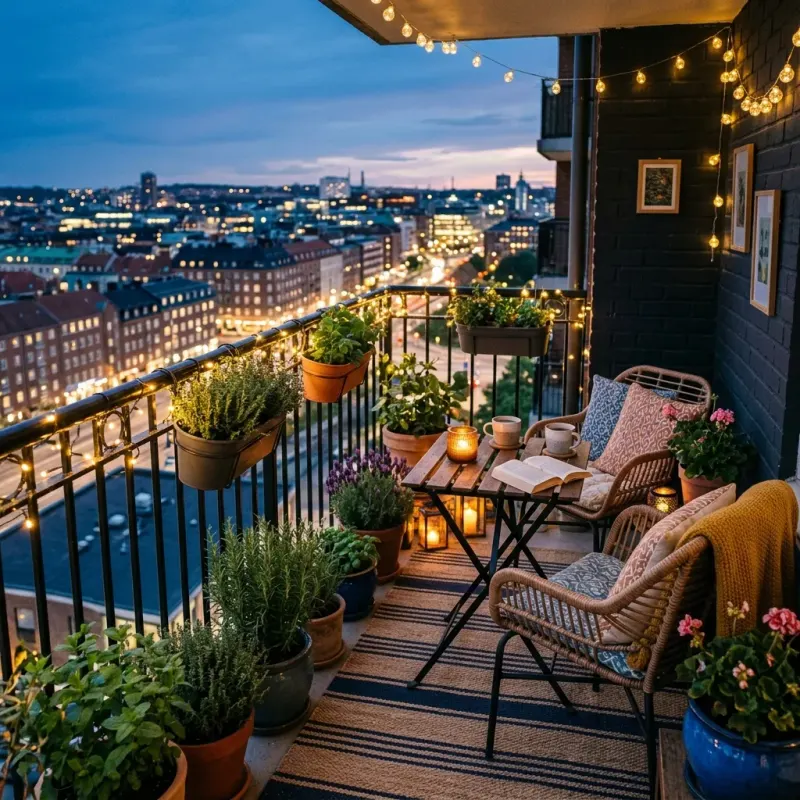
How to Transform a Small Balcony Into a Beautiful Urban Sanctuary
Apartment living in South Africa's major cities — Johannesburg, Cape Town, Durban, Pretoria — has become the norm for millions of urban women. Smaller footprints, higher-rise living, and the densification of city centres mean that for many of us, a balcony is our only private outdoor space. It may be modest in size. It may currently be used as storage for things that don't fit inside. But with the right approach, even the most unpromising concrete slab can be transformed into a space you genuinely love to spend time in — a morning coffee retreat, an evening cocktail spot, a reading nook, or a small growing garden that connects you to nature in the middle of the city.
This guide covers everything you need to know to maximize your balcony in a specifically South African context — accounting for our intense summer sun, the Highveld afternoon thunderstorms, coastal salt winds, and the security and privacy considerations unique to urban SA apartment living.
Before You Start: Practical Considerations for SA Balconies
Before buying furniture or plants, a few practical checks will save you money and frustration:
- Weight limits: Apartment balconies have structural weight limits. Large planters filled with wet soil, stone tiles, and heavy furniture add up quickly. Check your sectional title rules or ask your building manager for the load capacity before adding anything heavy. As a general rule, lightweight composite decking, aluminium furniture, and plastic or fibreglass planters are safer choices than stone, solid wood, or ceramic.
- Wind exposure: South African balconies — particularly above the 3rd floor in cities like Cape Town or the Highveld — can be extremely windy. Choose furniture that is heavy enough not to blow over, or invest in balcony windbreaker screens. Lightweight parasols and tall, unstable plants are dangerous in high-wind conditions.
- Sun orientation: In South Africa, north-facing balconies receive the most sun year-round (because we are in the southern hemisphere). East-facing balconies get morning sun and afternoon shade — ideal for most plants. West-facing balconies get intense, hot afternoon sun. South-facing balconies receive the least sun and are best suited to shade-loving plants.
- Sectional title rules: Many SA apartment complexes have body corporate rules governing what you can install on your balcony — including restrictions on permanent structures, certain types of lighting, clotheslines, or large containers. Review your rules of conduct before making any permanent changes.
1. Think Vertically — The Key to Small Space Transformation
The single most powerful principle for small balcony design is vertical thinking. Most people instinctively plan from the floor up, but on a small balcony, floor space is precious. The walls, railings, and vertical space above head height are your most underutilized assets.
Vertical planting options:
- Wall-mounted planters: Railing-mounted or wall-fixed planters bring greenery up off the floor entirely. Staggered heights create a lush, layered effect that looks far more abundant than the actual number of plants suggests. Succulents, herbs, trailing Pothos, and compact ferns all work beautifully in wall planters on SA balconies.
- Tiered plant stands: A three or four-tier plant stand in a corner provides display space for six to twelve plants in a footprint of less than half a square metre. Choose powder-coated steel or aluminium for durability against rain and humidity.
- Trellis and climbers: A simple timber or metal trellis fixed to a wall or railing, planted with a climbing jasmine, bougainvillea, or passionfruit vine, can transform a bare wall into a living privacy screen within one growing season. Bougainvillea in particular is extraordinarily hardy in South African conditions — drought-tolerant, fast-growing, and spectacular in flower.
- Hanging baskets: Spider Plants, trailing Pothos, and Ivy all cascade beautifully from hanging baskets fixed to the ceiling or balcony soffit, bringing greenery into the eye-level zone without using floor space.
Vertical storage: Pegboards, wall-mounted hooks, and slim vertical shelving units bring storage off the floor and onto the walls — freeing up precious floor space for furniture and plants. A pegboard with hooks is particularly useful for gardening tools, small pots, and watering cans that would otherwise clutter the floor.
2. Choose the Right Furniture — Multi-Functional and Appropriately Scaled
Furniture selection is where most small balcony transformations succeed or fail. The most common mistake is choosing furniture that is simply too large for the space — a full-sized outdoor sofa on a 3m × 2m balcony leaves no room to move and makes the space feel more cramped, not more comfortable.
Scale correctly first: Measure your balcony precisely before purchasing anything. Leave at least 60–80cm of clear walkway space around any seated furniture for comfortable movement. Draw a simple floor plan and mark where your door opens — you need clear access.
Best furniture choices for small SA balconies:
- Folding bistro sets: A small folding table and two folding chairs — ideally in powder-coated steel or aluminium — is the classic small balcony solution, and it remains the best. It looks elegant, takes up minimal space, and can be folded flat against the wall when you need the floor space. The French bistro aesthetic translates beautifully to South African balconies.
- Storage benches: A weather-resistant bench with lift-up storage inside serves as seating, a surface for plants or drinks, and a hiding place for potting soil, extra cushions, and gardening tools simultaneously. One piece doing three jobs is always a win on a small balcony.
- Wall-mounted drop-leaf table: For the very smallest balconies (under 4m²), a wall-mounted drop-leaf table that folds flat when not in use gives you a dining or work surface without permanently consuming floor space. Pair with folding or stacking chairs for maximum flexibility.
- Hammock chair: A single point hammock chair suspended from a balcony ceiling can create the most relaxed seating option possible in a very small footprint — ideal for a reading nook aesthetic. Ensure your ceiling fixing point is load-rated (consult your building manager).
Material considerations for SA conditions: Choose materials that can handle the full range of South African weather — intense UV, summer rain, coastal salt air, or Highveld hail. Powder-coated aluminium, all-weather rattan (synthetic), teak, and UV-stabilized plastics all perform well. Avoid untreated steel (rusts rapidly), untreated pine (warps and splits), and glass surfaces (dangerously fragile in high-rise wind conditions).
3. Create Shade and Privacy — The SA Non-Negotiables
South African balconies face two conditions that European balcony design guides rarely address: intense UV radiation that makes unshaded daytime sitting genuinely uncomfortable and medically risky, and the security and privacy considerations of urban apartment living. Solving both transforms a balcony from a barely-used space into one you actually want to spend time in.
Shade solutions:
- Shade sail: A tensioned shade sail is the most cost-effective, attractive, and SA-appropriate shade solution for a balcony. Choose a sail rated UV50+ (the same rating used for swimwear — it blocks 98%+ of UV radiation). They are available in dozens of colours, require no permanent structure, and can be removed and stored in two minutes if bad weather is forecast. Fixings can be attached to wall anchors and the balcony railing.
- Outdoor umbrella: A cantilever (offset pole) parasol gives you adjustable directional shade without a central pole interrupting the seating area. Choose one rated for UV protection with a weighted base appropriate for your wind conditions.
- Pergola with shade cloth: For larger balconies or those willing to invest more, a lightweight aluminium pergola frame covered with shade cloth (30–50% UV block, to allow some light through for plants below) creates a permanently shaded zone that transforms how you experience the space.
Privacy solutions:
- Bamboo or reed screening: Bamboo screening panels fixed to the inside of your railing create immediate visual privacy from neighbours and street level. They also act as a windbreak, reduce noise, and look beautifully natural against a plant-filled balcony. Available in various heights at most garden centres and hardware stores across SA.
- Tall potted plants: A row of tall, dense potted plants — Bamboo, Liriope, or columnar Rosemary — along the railing edge creates a living privacy screen that doubles as greenery and sound absorption.
- Outdoor curtains: Side panels of weatherproof fabric hung from a tension wire or curtain rod create a soft, draped privacy element that adds a touch of luxury to the space. Choose a UV-resistant outdoor fabric to prevent rapid fading.
4. Add Lighting for Year-Round Evening Use
Lighting is the single most impactful finishing touch for any balcony space — it is what transforms the space from something you use during daylight hours to a destination you gravitate toward on warm South African evenings.
- String lights / festoon bulbs: Warm-white Edison-style festoon string lights draped along the railing or overhead are the most universally flattering and atmospheric lighting choice for any outdoor space. In a country with as much evening electricity uncertainty as South Africa, choose solar-powered festoon lights — they charge fully during our abundant daylight hours and run for 6–10 hours after dark with no wiring and no electricity cost.
- Solar lanterns: Place solar lanterns on tables, the floor, or hang them from the trellis. They add pools of warm light at different heights, creating depth and intimacy in the space.
- Rechargeable LED candles: Battery-operated or USB-rechargeable LED candles on the table are a safe, loadshedding-proof alternative to real candles — particularly important given the fire risk of real candles on a shared apartment balcony. Modern LED candles have become convincingly realistic in their flicker and warmth.
5. Build Your Balcony Garden — Edible and Ornamental
A balcony garden in South Africa can be genuinely productive. With our exceptional year-round sunshine, many vegetables, herbs, and fruits that struggle in European apartment gardens thrive here with minimal effort.
Herbs that perform well on SA balconies: Basil, rosemary, thyme, chives, mint (in its own container — it spreads aggressively), flat-leaf parsley, and lemongrass. These can be grown in compact pots, railing planters, or vertical herb towers, and provide fresh flavour within arms reach of your kitchen.
Vegetables suited to balcony growing: Cherry tomatoes, spring onions, spinach, lettuce, chillies, and dwarf beans all perform well in containers on SA balconies. Use potting mix (not garden soil, which compacts in containers), ensure excellent drainage, and water more frequently than you would for in-ground planting — containers dry out significantly faster than beds.
Ornamental plants for colour and texture: Bougainvillea, Geraniums (Pelargoniums), Petunias, Lobelia, and Gazanias are all exceptionally heat and drought-tolerant, produce abundant colour from early spring through summer, and are widely available at SA garden centres for very little money.
For water-wise plant choices that look beautiful and are specifically adapted to South African conditions, read our companion guide on sustainable water-wise gardening. And if you want to bring the balcony feeling inside, our guide to low-maintenance indoor plants for SA homes will help you fill your apartment with life and greenery.