
The Best Low-Maintenance Indoor Plants for South African Homes
There is something profoundly restorative about living with plants. Research published in the Journal of Physiological Anthropology found that interacting with indoor plants reduces physiological and psychological stress — measurably lowering cortisol levels and blood pressure. NASA's landmark Clean Air Study documented the ability of specific indoor plants to remove volatile organic compounds (VOCs) like benzene, formaldehyde, and trichloroethylene from indoor air — compounds that off-gas from furniture, paint, carpets, and cleaning products, and that accumulate in South African homes where windows are frequently kept closed during cold Highveld winters or humid coastal summers.
The problem is that most indoor plant guides are written for temperate northern hemisphere climates. South Africa's conditions are fundamentally different: intense summer heat, dry Highveld winters, high UV light levels, and the erratic schedules of busy women who cannot always remember to water on cue. This guide covers the five indoor plants that genuinely thrive in South African home environments with minimal attention — along with detailed care guidance, troubleshooting tips, and styling ideas for each.
Why Indoor Plants Are Worth the Effort (Even a Small One)
Before getting into specific plants, it is worth understanding what you are actually getting from them beyond aesthetics:
- Air quality improvement: Indoor air can be two to five times more polluted than outdoor air. Plants absorb CO₂ and release oxygen through photosynthesis, and certain species absorb VOCs through their leaves and roots.
- Humidity regulation: Plants release moisture through transpiration. In the bone-dry air of a Highveld winter — when indoor humidity can drop to 20–30%, well below the comfortable 40–60% range — a cluster of plants can meaningfully improve respiratory comfort and reduce the dry-skin effects that even the best winter skincare routine cannot fully counteract.
- Mental health and focus: Multiple studies show that the presence of plants in work and living spaces reduces anxiety, improves concentration, and increases feelings of wellbeing. Even a single plant on a desk has a measurable effect.
- Noise reduction: Plants absorb, diffract, and reflect sound waves. Large leafy plants placed near windows or walls can reduce the intrusion of external noise — particularly useful in urban apartments.
1. Snake Plant (Sansevieria trifasciata / Dracaena trifasciata)
The Snake Plant — also called Mother-in-Law's Tongue or, in Afrikaans, Skoonma-se-tong — is the undisputed champion of low-maintenance indoor plants for South African conditions. It is, in the most literal sense, nearly impossible to kill through neglect, which makes it the ideal first plant for beginners and the most forgiving plant for busy households.
Why it excels in SA conditions: The Snake Plant is a succulent that stores water in its thick leaves, making it exceptionally drought-tolerant during periods of forgetfulness. It tolerates the full spectrum of South African indoor light conditions — from the deep shade of a north-facing bedroom to bright indirect light — and handles the temperature swings of our climate (hot summers, cold winters) without complaint. It is one of the very few plants documented by NASA to continue producing oxygen at night (most plants switch to respiring CO₂ after dark), making it ideal for bedrooms.
Care requirements:
- Water: Every 2–6 weeks, depending on season. In summer, water when the top 5cm of soil is dry. In winter, water once a month at most — overwatering in cold conditions is the primary cause of death in Snake Plants. Always let the soil dry completely between waterings.
- Light: Thrives in almost any light, from low to bright indirect. Avoid direct harsh midday sun through glass, which can scorch the leaves.
- Soil: A well-draining cactus or succulent mix is ideal. Standard potting soil tends to retain too much moisture.
- Feeding: A slow-release fertiliser once in spring and once in summer is all it needs.
- Toxicity: Mildly toxic to cats and dogs if ingested. Keep out of reach of pets.
Styling ideas: The Snake Plant's upright, architectural form makes it a natural focal point. A cluster of three in varying heights and varieties (try mixing the classic Laurentii with the rounder Moonshine variety) creates a dramatic, modern statement. It works beautifully in a bedroom corner, a home office, or as a structural anchor alongside softer, trailing plants.
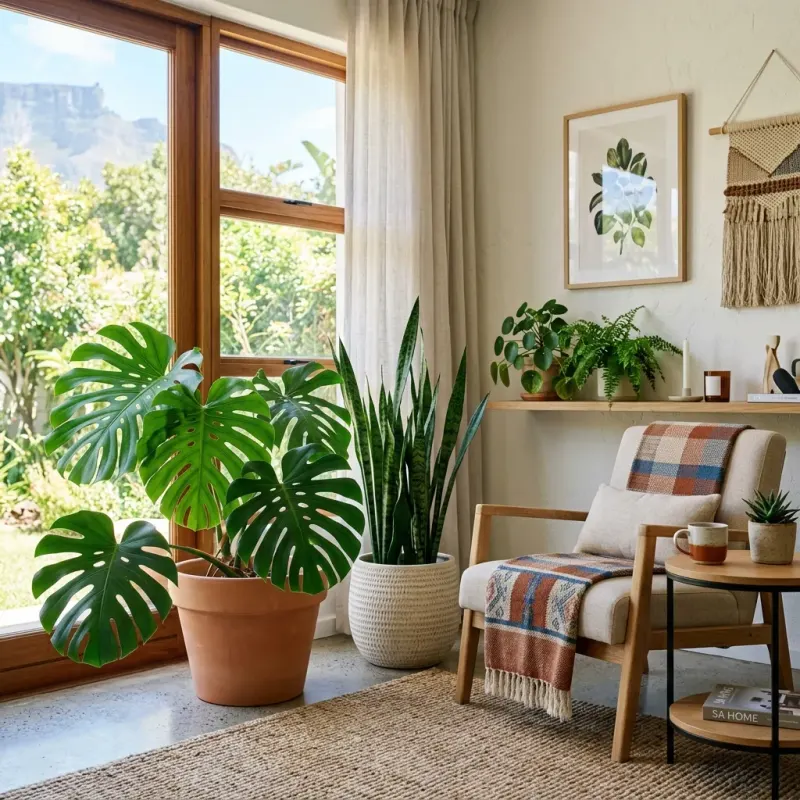
2. Monstera Deliciosa (Delicious Monster / Windowleaf)
The Monstera Deliciosa — called the Delicious Monster or Windowleaf in South Africa — has become one of the most iconic indoor plants of the 2020s, and for excellent reason. Its large, dramatically fenestrated (split and hole-punched) leaves are one of the most distinctive and beautiful forms in the plant kingdom, and it is far easier to care for than its exotic appearance suggests.
Why it excels in SA conditions: The Monstera is a tropical plant that genuinely loves the warm, bright conditions that South African summers provide. It is vigorous and fast-growing in good conditions, which makes it deeply satisfying to own — you see results. It thrives on the high ambient humidity of our coastal cities and copes well with the drier interior conditions when given adequate moisture. It is also one of the more forgiving plants when it comes to inconsistent watering.
Care requirements:
- Water: Water thoroughly when the top 3–5cm of soil is dry — approximately once a week in summer, once every 10–14 days in winter. Ensure the pot has drainage holes and never allow it to sit in standing water, which causes root rot.
- Light: Bright to medium indirect light is ideal. A spot a metre or two back from a large east- or north-facing window is perfect for most South African homes. Direct harsh sun bleaches the leaves.
- Support: As it grows, the Monstera produces aerial roots and benefits from a moss pole or stake to climb. This encourages the development of the large, dramatic fenestrated leaves — younger leaves without support tend to remain smaller and less perforated.
- Humidity: Benefits from occasional misting in dry winter conditions, or placement near a small humidifier.
- Toxicity: Toxic to cats and dogs. Keep out of reach of pets.
Styling ideas: The Monstera is a statement piece that deserves space. Give it room to grow in a large floor pot in a living room corner, alongside a reading chair. Its tropical aesthetic pairs beautifully with natural rattan, warm timber tones, and linen textures. For a cohesive look, pair with a trailing Pothos or a structural Snake Plant nearby.
3. ZZ Plant (Zamioculcas zamiifolia)
The ZZ Plant is the plant for people who believe they cannot keep plants alive. It is so astonishingly tolerant of neglect, low light, and irregular watering that it has earned the unofficial title of "the plant that refuses to die." If you have a dark corner, an irregular schedule, or a history of killing every plant you have ever owned, the ZZ Plant is your answer.
Why it excels in SA conditions: The ZZ Plant stores water in large underground rhizomes — essentially potato-like tubers that act as a reservoir. This means it can survive weeks or even months without watering without experiencing any visible distress. It handles the low-light conditions of east-facing apartments and shaded interiors better than almost any other plant. Its waxy, deep green leaves require no special humidity and are unfazed by air conditioning or indoor heating.
Care requirements:
- Water: Once every 3–4 weeks in summer; once every 6–8 weeks in winter. Truly. If in doubt, do not water. The ZZ Plant's cause of death is almost always overwatering — yellow stems are the first warning sign.
- Light: Low to medium indirect light. It tolerates very low light better than almost any other plant, though it will grow faster with more light. Never place in direct sun.
- Soil: A well-draining mix is essential given how little it needs to be watered. Cactus mix or standard potting soil mixed with perlite works well.
- Growth rate: Slow to moderate — this is not a plant for impatient growers, but its longevity and reliability more than compensate.
- Toxicity: Mildly toxic to humans, cats, and dogs if ingested. Wash hands after handling.
Styling ideas: The ZZ Plant's architectural structure and glossy leaves look particularly striking in minimalist or contemporary interiors. A tall ZZ in a matte white or concrete-effect pot alongside a low sideboard or bookshelf creates an effortlessly modern vignette. It also works beautifully in home office corners where light levels are lower.
4. Spider Plant (Chlorophytum comosum)
The Spider Plant is one of the most cheerful and adaptable indoor plants available — and one of the most generous, producing cascading "spiderettes" (baby plants on long runners) that can be propagated endlessly and gifted to friends and family. It is also one of the most thoroughly studied air-purifying plants, with NASA research documenting its exceptional ability to remove carbon monoxide, xylene, and formaldehyde from indoor air.
Why it excels in SA conditions: The Spider Plant is remarkably adaptable to different lighting conditions, tolerates a wide temperature range, and bounces back quickly from periods of neglect. It is one of the very few indoor plants that is completely non-toxic to cats and dogs — making it the top choice for pet-owning households. Its trailing habit makes it ideal for high shelves, hanging baskets on verandas, and bathroom windowsills where few other plants thrive.
Care requirements:
- Water: Water when the top 3cm of soil is dry — approximately once a week in summer, every 10–14 days in winter. They are relatively forgiving of missed waterings but do not like to be consistently waterlogged.
- Light: Adapts to low, medium, or bright indirect light. The variegated varieties (green and white striped) retain their colouring best with more light; solid green varieties tolerate lower light well.
- Propagation: The easiest plant to propagate in existence — simply place a spiderette in a glass of water until roots develop (1–2 weeks), then pot in soil. A wonderful sustainable practice and a thoughtful gift.
- Toxicity: Non-toxic to cats and dogs. The safest choice for pet owners.
Styling ideas: Spider Plants are at their most beautiful when allowed to trail freely. Hang them in macramé plant hangers in a sunny kitchen, bathroom, or bedroom. They pair beautifully with terracotta pots and bohemian interiors. A cluster of propagated babies in small matching pots on a windowsill makes a charming, living display.
5. Peace Lily (Spathiphyllum wallisii)
The Peace Lily is the rare indoor plant that flowers readily in South African indoor conditions without requiring direct sunlight — making it the go-to choice for anyone who wants the beauty and energy of a flowering plant in a lower-light environment. Its elegant white spathes (the "flowers" are technically modified leaves surrounding a central spadix) create a serene, sophisticated presence that few other indoor plants can match.
Why it excels in SA conditions: The Peace Lily thrives in the warm, humid conditions of coastal South African homes and adapts well to the drier inland environments with a little extra attention to humidity and watering. It has a built-in early warning system that no other plant offers: its leaves visibly droop when it needs water, then recover completely within a few hours of being watered. This makes it essentially impossible to forget to water — the plant tells you itself.
Care requirements:
- Water: Water when the leaves begin to slightly droop — approximately once a week in summer, every 10–14 days in winter. Use room-temperature water; cold water can shock the roots.
- Light: Low to medium indirect light. Avoid direct sun, which scorches the leaves. A north-facing room or a spot a few metres from a window is ideal.
- Humidity: Benefits from higher humidity — mist regularly during dry Highveld winters or place the pot on a tray of pebbles with water. Avoid placing near air conditioning vents, which dry out the air rapidly.
- Flowering: Flowers most abundantly in spring and summer with adequate indirect light. Wipe dust off leaves periodically to keep photosynthesis efficient.
- Toxicity: Toxic to cats, dogs, and children if ingested. Choose with care in households with curious pets or toddlers.
Styling ideas: The Peace Lily's clean white flowers and deep green leaves look most striking against dark walls or in rooms with rich, moody palettes — deep greens, navy, or charcoal. They are a natural fit for bathrooms (which tend to have the right humidity levels), bedrooms, and living room side tables.
Universal Care Rules for South African Indoor Plant Success
- Drainage holes are non-negotiable: Every pot must have at least one drainage hole. Decorative pots without holes should be used as cachepots (outer sleeves) with the plant remaining in its practical nursery pot inside. Waterlogged soil causes root rot — the primary cause of death for indoor plants in SA.
- Check before you water: Push your finger 3–5cm into the soil before watering. If it feels moist at that depth, wait. Overwatering kills more South African houseplants than anything else.
- Dust the leaves: South African homes accumulate dust rapidly. Wipe leaves with a damp cloth every few weeks. Dusty leaves cannot photosynthesize efficiently and are more vulnerable to pests.
- Fertilise in the growing season: Spring and summer are your plants' active growth periods. A diluted balanced liquid fertiliser once a month during these months is all most indoor plants need. Do not fertilise in winter when plants are resting.
- Watch for pests: Common South African indoor plant pests include mealybugs (white cottony clusters), scale insects (brown lumps on stems), and spider mites (fine webbing on undersides of leaves). Treat immediately with neem oil spray or insecticidal soap before infestations spread.
Once you have your indoor plants thriving, extend that green touch to your outdoor space with our guide to maximizing small balcony spaces — and explore water-wise gardening for sustainable outdoor planting suited to the SA climate.