
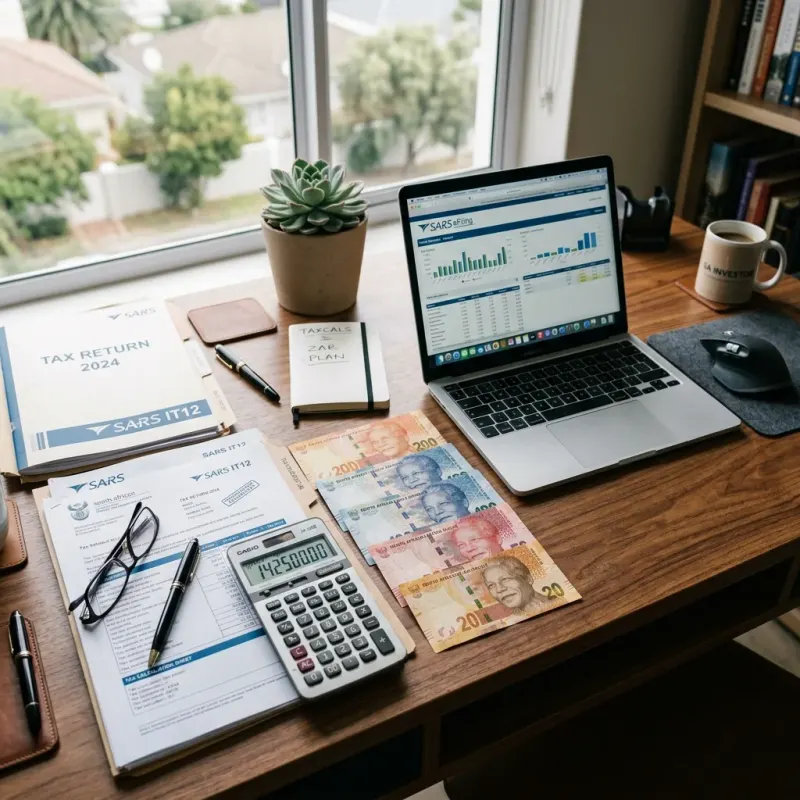
If you work from home in South Africa, you may be able to claim a portion of your home expenses as a tax deduction — but the rules differ significantly depending on whether you are an employee or self-employed, and SARS has specific requirements that many remote workers unknowingly fail to meet. This guide explains exactly who qualifies, what you can claim, how to calculate it, and how to submit it on eFiling without triggering an audit.
The Two Categories: Employee vs Self-Employed
Self-Employed (Sole Proprietor or Freelancer)
If you run your own business or work as an independent contractor (not on a fixed-term employment contract), you can generally claim home office expenses as business expenses under Section 11(a) of the Income Tax Act. The rules are more flexible for self-employed individuals, and you can claim expenses directly related to your business activity.
Employee (Receiving a Salary with PAYE Deducted)
For employees, the rules are more restrictive. Under Section 23(b) of the Income Tax Act, an employee can only claim a home office deduction if all three of the following apply:
- The employer does not provide the employee with an office or work space
- More than 50% of the employee's duties are performed in the home office
- The part of the home used as the office is used regularly and exclusively for work — it cannot also be used as a bedroom, guest room, or lounge
This "exclusively used" requirement is strict. A desk in your bedroom does not qualify. A dedicated room used only for work does qualify.
What Expenses Can You Claim?
Once you establish that you qualify, the following expenses are potentially deductible:
- Rent paid (if you rent your home)
- Bond interest (the interest portion of your mortgage, not capital repayments)
- Municipal rates and taxes
- Electricity and water
- Levies (in an estate or sectional title)
- Cleaning costs attributable to the office
- Home insurance (proportionate to the office area)
- Wear and tear on office furniture and equipment (separate calculation — Section 11(e))
- Internet and telephone costs (the business-use portion)
Note: Groceries, clothing, or any personal expenses do not qualify. Internet and telephone must be apportioned between personal and business use.
How to Calculate Your Deduction
SARS uses a floor space apportionment method. The formula is:
Deductible amount = (Office floor area ÷ Total home floor area) × Total qualifying home expenses
Example: Your home is 120 square metres. Your dedicated office is 12 square metres (10% of total). Your total qualifying home expenses for the year are R120,000 (rent, electricity, rates). Your deduction is 10% × R120,000 = R12,000.
Measure your rooms carefully. SARS may request floor plans or an affidavit confirming the measurements if audited.
Capital Gains Tax Warning for Homeowners
If you own your home and claim a home office deduction, SARS may apply a proportional Capital Gains Tax (CGT) exclusion when you eventually sell. Normally your primary residence is exempt from CGT on the first R2 million of gain. But if 10% of your home was used exclusively for business, that 10% does not qualify for the primary residence exclusion. Consider this carefully before claiming — for some homeowners, the annual deduction is worth less than the future CGT exposure.
This concern does not apply to renters.
How to Claim on SARS eFiling
- Log in at efiling.sars.gov.za
- Open your ITR12 (personal income tax return)
- Under "Deductions," look for the home office section
- Enter the floor area ratio, total expenses, and the calculated deduction
- Keep all supporting documents for 5 years: lease/bond statements, municipal bills, electricity invoices, internet bills, and a floor plan or sketch
If you receive an ITA34 after submitting and your return is selected for verification, SARS will request these documents. Having them organised prevents delays.
Equipment and Office Furniture
Office equipment (desk, chair, monitor, laptop) used exclusively for work can be claimed as a wear and tear allowance under Section 11(e). SARS prescribes the write-off period — generally 3 years for computer equipment and 6 years for office furniture. Keep your purchase receipts.
What Remote Workers Often Miss
- Internet and data costs: If you upgraded your home fibre package specifically for work, the incremental cost (or business-use proportion) is deductible.
- Stationery and printing: Deductible as office supplies if used exclusively for work.
- Subscriptions: Software, cloud storage, and tools used only for work (Microsoft 365, Xero, Adobe) are deductible — keep receipts and invoices.
Frequently Asked Questions
Can I claim if I only work from home two days a week?
For employees, the requirement is that more than 50% of your duties are performed in the home office. If you work 2 days at home and 3 days in the office, you likely do not meet the 50% threshold. For self-employed individuals working from home any number of days, a proportionate claim is possible.
My employer gave me a monthly home office allowance. Can I still claim?
The allowance is added to your taxable income (it should appear on your IRP5). You may then claim your actual qualifying home office expenses against this. If your actual expenses exceed the allowance, the net deduction reduces your taxable income. Keep all receipts to substantiate the claim.
Do I need a tax practitioner to claim this?
Not necessarily — the calculation is straightforward for most people. However, if you own your home, are claiming significant amounts, or have a complex tax situation (investment income, multiple income streams), a SARS-registered tax practitioner can ensure you optimise your deductions and avoid errors. Tax practitioners registered with SAIT, SAIPA, or SAICA can be found on their respective websites.