
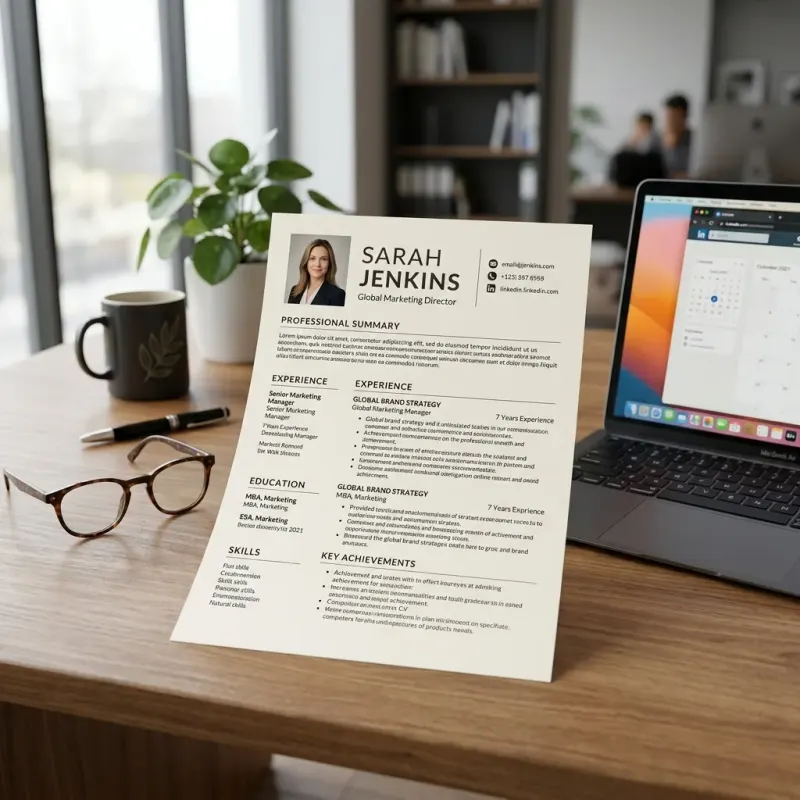
Let's be honest: writing a CV in South Africa in 2026 feels like navigating a minefield. You're competing in a market with a 32.1% unemployment rate, applying through algorithms that filter you out before a human even sees your name, and trying to figure out what's legal to include versus what could get your application tossed in the bin.
But here's the good news: once you understand what South African recruiters actually expect, you can craft a CV that gets past the filters and into the interview room. This guide is specifically for you — whether you're entering the job market for the first time, returning after maternity leave, or pivoting careers entirely.
What Makes a South African CV Different? (And Why It Matters in 2026)
If you've been Googling CV templates, you've probably noticed most advice is written for the American or British market. That's a problem. South African recruiters have specific expectations that differ significantly from international standards.
Here's the biggest difference: South African CVs are typically 2-3 pages long. Unlike the US, where a one-page resume is gospel, SA employers expect more detail. They want to see your full career trajectory, your qualifications, and evidence of your skills. A one-page CV in South Africa can actually work against you — it may signal that you don't have enough experience.
Another key distinction is the reverse-chronological format, which remains the gold standard. Recruiters at companies like Shoprite, Standard Bank, or Discovery Health want to see your most recent role first. It's what they're trained to scan for, and it's what Applicant Tracking Systems (ATS) on platforms like PNet and CareerJunction are programmed to parse.
And speaking of ATS — this is where most CVs die. PNet alone processes over 10 million applications annually in South Africa. If your CV isn't formatted correctly for their algorithm, it won't matter how qualified you are. We'll cover exactly how to optimise for these systems later in this guide.
The Perfect SA CV Structure: What to Include and in What Order
Think of your CV as a story about your professional life — but one that needs to make sense in the first 10 seconds. Here's the structure that works for the South African market:
- Personal Details (keep it clean and compliant)
- Professional Summary (3-4 lines that sell you)
- Work Experience (reverse-chronological, with achievements)
- Education and Qualifications (highest first)
- Skills (hard and soft, tailored to the role)
- References ("available on request")
Save your CV as a PDF — this prevents formatting issues when recruiters open it on different devices. And name your file properly: "FirstnameSurname_CV_2026.pdf". It sounds small, but recruiters notice professionalism in the details.
Personal Details Section: What's Legal, What's Expected, and What to Leave Out
This is where many South African women accidentally sabotage their applications. The Employment Equity Act (EEA) and the Protection of Personal Information Act (POPIA) protect you from having to disclose certain personal information — and employers are legally not allowed to request it upfront.
Include:
- Full names (as they appear on your ID)
- Contact number (with +27 country code)
- Professional email address (firstname.surname@email.com, not partygirl99@hotmail.com)
- City and suburb (you don't need your full street address — privacy matters)
- LinkedIn profile URL (78% of SA recruiters now expect this)
Do NOT include:
- Your ID number
- Your race or ethnicity
- Marital status or number of children
- A photograph
- Your age or date of birth
These protections exist for a reason. Including them can actually make recruiters uncomfortable — it signals that you may not understand workplace legislation, which isn't the first impression you want to make.
Writing Your Professional Summary for the South African Job Market
Your professional summary is your elevator pitch. It sits at the top of your CV and needs to answer one question immediately: "Why should I keep reading?"
Keep it to 3-4 lines maximum. Write in first or third person (just be consistent). Here's what to include:
- Your industry and years of experience
- 2-3 key skills or specialisations
- A quantifiable achievement if possible
- Language proficiencies (this matters enormously in SA)
Here's an example:
"Results-driven marketing professional with 8 years of experience in the FMCG sector across South Africa and SADC markets. Skilled in digital campaign management, brand strategy, and cross-functional team leadership. Fluent in English, Afrikaans, and isiZulu. Achieved 34% increase in brand awareness for a major retail client in 2024."
Notice the language mention? In South Africa, multilingualism is a genuine competitive advantage. If you speak more than one language, say so. And if you have a driver's licence and own transport, mention it too — in a country where public transport is unreliable, this can be the difference between getting an interview and being overlooked.
How to Present Your Work Experience (Even with Gaps or Career Changes)
Let's address the elephant in the room: employment gaps. In a country with 32.1% unemployment, career breaks are normal. Women in South Africa disproportionately take time off for caregiving, maternity leave, or family responsibilities. Recruiters know this.
The key is to address gaps honestly but strategically. You don't need to apologise for them. If you took two years off to raise children, you can note "Career break — family responsibilities" and then highlight any skills you developed during that time (volunteer work, freelance projects, online courses).
For each role, include:
- Company name and your job title
- Dates in MM/YYYY format (e.g., 03/2021 – 08/2024)
- 4-6 bullet points with quantifiable achievements
Don't just list duties — show impact. Instead of "Responsible for social media management," write "Grew Instagram following from 5,000 to 22,000 in 12 months, increasing online sales by 18%."
Use South African terminology: say "matric" not "high school diploma," "tertiary education" not "college," and "CV" not "resume." If your roles involved BEE compliance, stakeholder management with government departments, or SETA-related training, mention it — these are highly relevant in the SA context.
Education and Qualifications: The SA Way
List your highest qualification first, then work backwards. Include the institution name — South African employers recognise and respect local institutions like the University of Cape Town, Wits, Stellenbosch, University of Pretoria, UKZN, and Tshwane University of Technology.
If you're a recent graduate, include your matric results — especially if you achieved a Bachelor's pass or higher. As you gain work experience, you can remove this section.
Don't forget professional registrations. These carry significant weight in South Africa:
- SAICA for accountants
- SACAP for project and construction management professionals
- ECSA for engineers
- HPCSA for health professionals
If your qualification is SAQA-accredited or you know its NQF level, include this information. It helps employers verify your credentials quickly.
Skills That South African Employers Actually Want to See
Split your skills into Hard Skills and Soft Skills. This makes it easy for recruiters to scan and for ATS systems to categorise you.
Hard Skills to consider:
- Microsoft Office Suite (still the backbone of most SA offices)
- Sage Pastel or VIP Payroll (essential for accounting and HR roles)
- SAP (widely used in South African corporates)
- Zoom, MS Teams, Google Workspace (remote work is here to stay)
- Any industry-specific software
Soft Skills that matter in SA:
- Cross-cultural communication (our workplaces are incredibly diverse)
- Adaptability and resilience
- Stakeholder management
- Problem-solving in resource-constrained environments
And again — include your driver's licence code. Code 08/EB is standard for most roles. If you have Code 10/C1 or Code 14/C, definitely mention it. If you own your own vehicle, say so.
Getting Past Applicant Tracking Systems on PNet and CareerJunction
This is the technical bit that most CV guides ignore — but it could be the most important section you read.
When you apply for a job on PNet, CareerJunction, or Indeed South Africa, your CV doesn't go straight to a recruiter. It goes through an Applicant Tracking System that scans for keywords, formatting, and relevance before a human ever sees it.
Here's how to beat the bots:
- Use keywords from the job advert — if the posting says "project management," use "project management" in your CV, not "project coordination"
- Use standard headings — "Work Experience" not "Where I've Made Magic Happen"
- Avoid tables, text boxes, and graphics — ATS systems can't read them
- Don't put critical information in headers or footers
- Tailor your CV for each application — generic CVs get filtered out
ATS keyword list for top SA industries:
Finance: financial reporting, IFRS, SARS compliance, audit, budgeting, Sage Pastel, SAICA
Retail: merchandising, stock management, point-of-sale, customer experience, shrinkage
Healthcare: patient care, HPCSA, clinical governance, NHI, primary healthcare
Education: curriculum development, CAPS, assessment, inclusive education, SACE
Tech: Agile, Scrum, Python, cloud computing, cybersecurity, DevOps
Common CV Mistakes That Cost South African Women the Interview
After reviewing hundreds of CVs from South African women, these are the mistakes we see most often:
1. Including salary expectations. Unless the job advert explicitly asks for this, leave it out. It can price you out of a role or signal that you haven't researched the market.
2. Using overseas CV templates. Templates designed for the US or UK market often include sections that are irrelevant or even problematic in South Africa. Stick to SA-specific formats.
3. Listing every job since matric. Focus on the last 10-15 years. Your first job at 18-year-old at a fast-food chain probably isn't relevant anymore.
4. Grammar and spelling errors. South African employers are particularly strict about English proficiency. If writing isn't your strength, ask someone to proofread your CV or use a tool like Grammarly. This is non-negotiable.
5. Not tailoring for each application. Sending the same generic CV to 50 jobs is the fastest way to get 50 rejections. Spend 15 minutes customising your CV for each role — it dramatically increases your chances.
6. Underselling yourself. Women in South Africa often downplay their achievements. If you led a team, say so. If you increased revenue, quantify it. You're not bragging — you're informing.
References: The Final Touch
Simply write "References available on request" at the bottom of your CV. Don't list your references' details on the CV itself — that's what POPIA is for.
Have 2-3 references ready — ideally former managers or supervisors who can speak to your work. Make sure they have South African contact numbers in +27 format. And never, ever use family members or friends as professional references.
Pro tip: Give your references a heads-up before listing them. A recruiter calling an unprepared reference who says "Who?" doesn't help your case.
Your CV Is Your Ticket — Make It Count
In South Africa's competitive job market, your CV isn't just a document — it's your first impression, your advocate, and often your only shot at getting through the door. The women who land interviews aren't always the most qualified on paper; they're the ones who understand what the market expects and deliver it with confidence.
You don't need to spend R2,500 on a professional CV writing service (though if you can afford it, it's an investment worth considering). You need to understand the rules of the game — and now you do.
Download a clean, SA-specific CV template. Tailor it for each application. Beat the ATS filters. And walk into that interview knowing your CV already did the hard work for you.
You've got this.
Frequently Asked Questions
How long should a CV be in South Africa?
South African CVs are typically 2-3 pages long. Unlike the American one-page resume standard, SA employers expect more detail about your career history, qualifications, and skills. If you're a recent graduate with limited experience, one page is acceptable, but as your career progresses, aim for two to three pages. Never exceed three pages unless you're in academia or a senior executive role.
Should I include my photo on my South African CV?
No. Under the Employment Equity Act, employers cannot request photographs, and including one can actually work against you. It may trigger unconscious bias or signal that you're unfamiliar with South African employment legislation. Keep your CV professional and focused on your skills and experience — your photo has no place on it.
What is the difference between a CV and a resume in South Africa?
In South Africa, the terms are often used interchangeably, but there is a distinction. A resume is typically a one-page summary of your skills and experience (more common in the US), while a CV (curriculum vitae) is a more detailed document — usually 2-3 pages — that includes your full career history, education, and skills. In the South African job market, employers expect a CV, not a resume. When a job posting asks for a CV, they want the detailed version.
Is it worth paying for a professional CV writing service in South Africa?
Professional CV writing services in South Africa typically cost between R500 and R2,500, depending on the level of service. If you're entering a highly competitive field, transitioning careers, or applying for senior roles, it can be a worthwhile investment. However, if you follow the guidelines in this article, you can create a strong CV yourself at no cost. Many women on a budget successfully land interviews with self-written CVs — what matters most is the content and structure, not how much you paid for it.
How do I address employment gaps on my CV as a South African woman?
Employment gaps are common in South Africa, especially among women who take career breaks for maternity leave, caregiving, or family responsibilities. The best approach is to address gaps honestly but briefly. You can include a simple line such as "Career break — family responsibilities (2023–2024)" and then highlight any skills, volunteer work, or courses you completed during that time. South African recruiters are generally understanding of career gaps given the country's economic reality — what they want to see is that you're ready and motivated to return to work.