
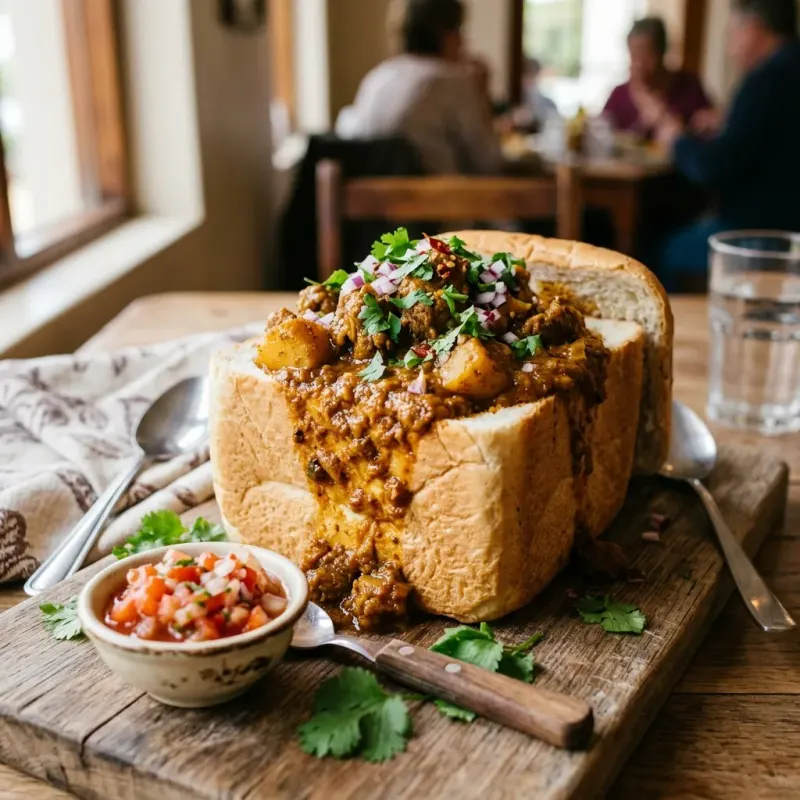
Bunny Chow — Durban's Most Iconic Street Food
Few dishes in the South African food story carry as much cultural weight, culinary history, and sheer deliciousness as the Bunny Chow. A hollowed-out quarter or half loaf of unsliced white bread filled to overflowing with curry — mutton, chicken, bean, or prawn — the Bunny is Durban's most iconic street food and one of the most uniquely South African eating experiences that exists anywhere in the world.
The origins of the Bunny Chow trace back to Durban's Indian community, most likely in the 1940s, when Indian food vendors in the Grey Street area needed a convenient, portable way to serve curry to workers who could not return home for lunch and were not permitted to eat at white-owned restaurants under apartheid segregation. The hollowed bread loaf solved both problems elegantly: it was its own container, it was filling, and the bread soaked up the curry sauce in a way that no conventional vessel could replicate. The "lid" — the piece of bread excavated from the loaf — sits on top and is eaten last, when it is saturated with curry.
Today, the Bunny Chow is eaten by South Africans of every background, celebrated in food festivals, and considered a cornerstone of national culinary identity. But the best Bunnies are still found in Durban, eaten with your hands (always — there is no cutlery involved), at a takeaway counter or on a plastic chair, with the juice running down your wrist.
This recipe makes a full-flavoured Durban-style curry that is worthy of a proper Bunny. The curry can also be served conventionally over rice, but do make it in a Bunny at least once — the bread-to-sauce ratio changes the entire experience.
Ingredients
Serves: 4 | Prep time: 20 minutes | Cook time: 60–75 minutes (or 30 minutes for chicken)
For the curry (mutton version — the classic):
- 1kg mutton or bone-in lamb pieces (shoulder or knuckles work best — bone adds enormous flavour)
- 2 large onions, finely diced
- 4 cloves garlic, minced
- 1 tbsp fresh ginger, grated
- 3 tbsp vegetable oil or ghee
- 3 tbsp Durban curry powder (Rajah Hot or a proper Durban masala blend — this is not the same as mild Cape curry powder)
- 1 tsp turmeric
- 1 tsp ground cumin
- 1 tsp ground coriander
- ½ tsp garam masala
- 4 medium potatoes, peeled and quartered
- 2 large ripe tomatoes, roughly chopped (or 1 tin chopped tomatoes)
- 1 cup (250ml) water
- Salt to taste
- Fresh coriander to finish
For the bread:
- 2 unsliced white bread loaves (the standard SA white bread — Albany or Sasko. The Bunny lives or dies on the bread)
Method
- Brown the meat: Heat the oil or ghee in a large, heavy-based pot (a cast iron potjie is traditional) over high heat. Season the mutton pieces with salt and add to the pot in batches — do not crowd the pan. Brown on all sides for 3–4 minutes per batch. Properly browned meat adds deep flavour to the final curry; grey, steamed meat does not. Remove browned meat and set aside.
- Build the base: Reduce heat to medium. Add the onions to the pot and cook in the remaining oil for 10 minutes, stirring occasionally, until deep golden and soft. Add the garlic and ginger, stir for 1 minute. Add all the spices (curry powder, turmeric, cumin, coriander, garam masala) and stir for 60–90 seconds until the pot is fragrant and the spices are toasted.
- Add the tomatoes: Add the chopped tomatoes and stir well, scraping up any browned bits from the bottom of the pot. Cook for 5 minutes until the tomatoes break down and the oil begins to separate from the masala base (you will see it pooling around the edges). This separation — called "bhunoing" — indicates the spices are properly cooked and the curry will have depth rather than rawness.
- Slow cook the curry: Return the browned mutton to the pot. Add the water and stir to combine. Bring to a boil, then reduce heat to the lowest possible setting, cover tightly, and simmer for 45 minutes. Add the potato quarters and continue cooking for a further 25–30 minutes until both the meat and potatoes are completely tender and the sauce has thickened. Taste and adjust salt. The curry should be rich, fragrant, and have a deep reddish-orange colour. Finish with fresh coriander.
- Prepare the bread: Cut each loaf into two equal halves to make quarter bunnies (or leave whole for a half bunny — a true Durban portion). Using your hands or a knife, hollow out the inside of each bread quarter, leaving a wall of bread approximately 2cm thick on all sides. Keep the excavated bread — this is the "lid" and will be eaten last. Do not toast, do not modify — the Bunny must be made from fresh, untoasted white bread.
- Load the Bunny: Fill each bread hollow generously with curry, ensuring each portion has a piece of meat and some potato. Ladle extra sauce over the top — the Bunny should be full to overflowing. Place the excavated bread piece on top as the lid.
- Eat correctly: Hold the bread base with both hands. There are no utensils. Eat the curry-soaked walls of the bread as you go. Eat the lid last when it is completely saturated. Have plenty of napkins. Enjoy completely.
Variations
- Chicken Bunny: Replace mutton with 1kg bone-in chicken pieces. Reduce the slow-cooking time to 30–35 minutes total. Chicken Bunny has a cleaner, lighter flavour that many people prefer.
- Bean Bunny (vegetarian): Replace the meat with 2 tins of kidney beans and 1 tin of chickpeas, both drained. Reduce cooking time to 20 minutes after adding the tomatoes. Bean Bunny is the most affordable version and is genuinely delicious — the beans absorb the curry sauce beautifully.
- Prawn Bunny: Add 500g large peeled prawns in the last 5 minutes of cooking. Prawn Bunny is the luxury version, popular in coastal Durban.
What to Serve Alongside
A traditional Bunny Chow needs nothing alongside it except perhaps a cold glass of water or a cold Coke. Some Durban establishments serve a simple carrot and onion salad (kachumber) on the side — thinly sliced carrots and onion dressed with lemon juice and fresh coriander. This cuts through the richness of the curry perfectly.